Learn How the U of A is Restoring Touch, and Hope, in Newest Short Takes
Short Takes tells the story of Dewey Hickey, the first Arkansan to benefit from a neural-enhanced prosthesis and the groundbreaking work done by I³R.
Read More

Short Takes tells the story of Dewey Hickey, the first Arkansan to benefit from a neural-enhanced prosthesis and the groundbreaking work done by I³R.
Read More
Angie Maxwell chosen as Carnegie Fellow.
Read More
College of Engineering and Institute for Integrative and Innovative Research partner with research team from Johns Hopkins University.
Read More

Latest Discover RED features work being done at the Harvell Civil Engineering Research and Education Center.
Read More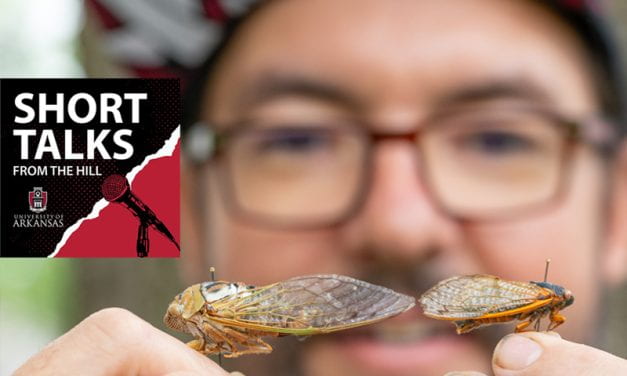
Entomologist Austin Jones discusses this summer’s co-emergence of two broods of periodical cicadas.
Read More
Psychology instructor Mitch Brown discusses his research on male formidability, or toughness, and how it informs stereotypes of personality and social functions.
Read More

University Breaks Ground on One-of-a-Kind Semiconductor Facility